I'd like to take this opportunity to respond to Edin's blog about what is stated in the CNET interview. As I mentioned in my response to Edin's blog entry, in the interview I never called out PHP 6 as a Zend product. I *did* talk about what's coming down the pipeline for PHP and mentioned that both Zend and Yahoo! have been contributing to the Unicode effort (which is true). One of my aims is to promote PHP proliferation and adoption, and talking about the support from organizations like Zend and Yahoo helps with that.
Zend is a commercial company working in the open source PHP community, as are Yahoo, IBM, Oracle and many others. There should not be an inherent conflict in that situation. We are very careful to acknowledge our relationship with the community – we point to the fact that there is such a large community of contributors to PHP as one of the key strengths of the technology (as can be seen in most of my presentations). We are also continually contributing significant Zend resources to the PHP community, working on PHP, Framework and the Eclipse IDE projects.
Our commercial activity is mostly around enabling larger corporations adopt PHP in a professional way, helping with architecture, training, development tools and runtime tools. The fact that these corporations adopt PHP further strengthens the community and creates opportunities for all of its participants.
Edin’s blog in part builds on a pre-existing perception that Zend claims more credit for PHP than it deserves. I acknowledge that there have been some unfortunate statements in the past that may have contributed to that perception. But that was years ago, and we have become very sensitive to that. Zend did not invent PHP, does not own PHP, etc. That goes for Zeev and I and all other Zenders. When we introduce ourselves we say that we are leading contributors to PHP, and I think we can make that case.
It’s also important to understand that it is *not* in Zend’s interest to claim that we are the only company behind PHP, that would make PHP look much smaller than it is which would be very counter productive to our quest for increasing PHP proliferation.
I think Stephen Shankland’s coverage of PHP and Zend are very positive, most of what he wrote is accurate. He may not be aware of the sensitivities in the community and so he describes PHP 6 in a way that it sounds like a Zend product. I did not say it, but Stephen writes the article from handwritten notes from the interview most probably a few hours later, so it is easy to see how that happens.
We will continue to promote PHP, the community, the contributors to it, the corporate support for it, and so forth. We are committed to make the whole community stronger, and will give continue to give credit to its many contributors.
Friday, July 21, 2006
Sunday, July 16, 2006
PHP 5 Adoption has Tipped!
PHP 5 was released in July 2004. Since its release two years ago, there has been a lot of talk about its adoption rate and whether it will surpass the PHP 4 installed base. Even a very narrow Google query will point you to a large amount of articles and blog entries on the subject. In December 2005, I was interviewed for internetnews.com and already pointed out then, that judging by support calls we get for our various products at Zend, almost 50% of development in PHP is being done on PHP 5. Still many weren't sure whether to believe that statistic as Web crawling stats in favor of PHP 4 were still showing a completely different picture.
No doubt that it will still take some time for PHP 5 to reach PHP 4's existing installed base. The main reason for this are the numerous PHP 4-based applications that were built over the years, and if it's not broken, don't fix it. Even at Zend, we have some apps which don't need to be maintained anymore, so we still run PHP 4 for those. But pretty much all new development is done with PHP 5.
That said, I think when judging adoption, the most important statistic is still understanding what people developing and building Web sites with PHP are actually using today. Last week I decided to check up on our support statistics again and see how things have changed in the last few months. I was pretty amazed with the latest results. Although I knew many were waiting for PHP 5.1 before upgrading, its release in last November seems to have created a huge increase in PHP 5 adoption. In July over 74% of support tickets were by customers using PHP 5 (and remember we do support both versions). You can see the results (in %) in the following graph. PHP 4 and PHP 5 are of course inverses of each other.
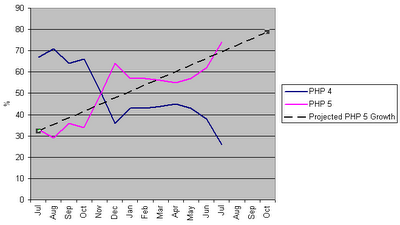
I've added a trendline to the graph which gives a good idea of how adoption seems to be quickly accelerating since the release of PHP 5.1. I'm the last one to recommend trusting such extrapolations on data, but there definitely seems to be some kind of trend here, and I think it's past the point of no return.
P.S. - Thanks to Shahar Evron, from our support team and contributor to the Zend Framework for getting me these stats.
No doubt that it will still take some time for PHP 5 to reach PHP 4's existing installed base. The main reason for this are the numerous PHP 4-based applications that were built over the years, and if it's not broken, don't fix it. Even at Zend, we have some apps which don't need to be maintained anymore, so we still run PHP 4 for those. But pretty much all new development is done with PHP 5.
That said, I think when judging adoption, the most important statistic is still understanding what people developing and building Web sites with PHP are actually using today. Last week I decided to check up on our support statistics again and see how things have changed in the last few months. I was pretty amazed with the latest results. Although I knew many were waiting for PHP 5.1 before upgrading, its release in last November seems to have created a huge increase in PHP 5 adoption. In July over 74% of support tickets were by customers using PHP 5 (and remember we do support both versions). You can see the results (in %) in the following graph. PHP 4 and PHP 5 are of course inverses of each other.

I've added a trendline to the graph which gives a good idea of how adoption seems to be quickly accelerating since the release of PHP 5.1. I'm the last one to recommend trusting such extrapolations on data, but there definitely seems to be some kind of trend here, and I think it's past the point of no return.
P.S. - Thanks to Shahar Evron, from our support team and contributor to the Zend Framework for getting me these stats.

Subscribe to:
Posts (Atom)